“Who is a God like you, who pardons sin and forgives the transgression of the remnant of his inheritance? You do not stay angry forever but delight to show mercy.” — Micah 7:18 (NIV)
Who is God?
This question started haunting me toward the end of 2025, as I was preparing to close one year and begin another. I was looking through my Bible, thinking about what I wanted to study next, trying to decide which book of the Bible I should read or what book I should pick up to accompany my time in the Word. And for some reason, the same question kept coming back to me: Who is God?
Now, you have to understand why this question was so strange to me. I know God! I’ve walked with the Lord for years, and I have a very real, vibrant, walk-by-my-side relationship with Him. I experience Him so personally when I read my Bible. There are moments when I can almost hear His voice through His Word, and when I pray, I can feel the Spirit guiding me in prayer. So it wasn’t that I was suddenly questioning whether I knew God or whether He was real. It was more like this question had been planted in my spirit, and I couldn’t quite shake it. Who is God? Not what does He want me to do? Not what does He have planned for my life? But who is He?
And the more I thought about it, the more I realized that although I had spent years studying the Bible, so much of my reading had been directed toward things I wanted to learn for my own life. How to be a better mother, how to grow spiritually, how to navigate relationships, how to serve Him better. And there’s nothing wrong with any of those things. But I began to feel this tremendous pull toward studying God Himself. I wanted to know His nature, His character, His attributes. I wanted to understand who He is, even apart from the things He does for me.
So, for the first time, I decided to dedicate the majority of my reading to that one pursuit. I read books like Mere Christianity by C. S. Lewis and The Knowledge of the Holy by A. W. Tozer. I also included Jen Wilkin’s None Like Him and In His Image in my devotional reading. And I found myself genuinely excited about all of it.
I remember asking the Lord, “Where can I find You in the Bible? I mean, I know You’re everywhere, but where should I go to learn about You?” And I felt drawn to Deuteronomy, which became such a beautiful place to study the heart of God. I wanted to see how a God like Him would establish a nation, what He considered important, what He commanded, what He loved, and what His dealings with His people revealed about His character. I also spent time in Matthew and Mark, getting to know Jesus through the Gospels, and in Revelation and Job. I wasn’t reading simply to finish another book of the Bible. I was on a quest to answer this question: Who is God?
And somewhere along the way, I discovered something that I don’t think I was expecting at all. The more I learned about who God is, the more I began to understand who I am not.
I am not God.
I know, I know. Quite the revelation, right? Haha! But stay with me, because this was genuinely one of the most humbling and freeing realizations of my life.
As I studied God’s attributes, I learned about what theologians call His communicable and incommunicable attributes. Fancy words, I know! They even made me feel like a little theologian for a moment. Haha! But the more I learned about the attributes that belong to God alone, the more I was confronted with how much of the turmoil in my own life came from trying to possess them. My judgment of others came from trying to be omniscient, as though I could know their hearts. My exhaustion came from trying to be omnipresent, as though I could be everywhere for everyone. My struggle with my limitations came from wanting to be self-sufficient, needing nothing and no one. And my fear of change came from longing for immutability, wanting circumstances to remain the same when only God is unchanging.
I realized how easily I could dishonor God’s character by attempting to sit on His throne. Not intentionally, of course. I wasn’t walking around thinking I could do a better job than God! But sometimes I was behaving as though everything depended on my abilities to do things that only He could.
We are called to reflect His character, not assume His responsibilities.
And while that realization was humbling, it was also incredibly freeing. Because yes, I am not God, but He is. And goodness, He is so good at being God.
That’s something I kept thinking throughout my reading. God is so good at being God! He knows when to forgive and when to correct. He knows the right time for everything. He is perfectly merciful and perfectly just. He knows what I cannot know, sees what I cannot see, and understands things I will probably never understand on this side of eternity. And the more I studied Him, the more I found myself resting in His sovereignty.
This morning, as I was reading Micah 7, I came across that beautiful question: “Who is a God like you?” And I smiled because here I was, after spending so much of this year asking who God is, reading a prophet who was marveling at the very same thing. Micah had been describing the unfaithfulness of God’s people, the corruption around him, and the difficulty of finding those who were righteous. And yet, when he turns his attention to God, he speaks of His compassion, His mercy, and His faithfulness to the promises He made.
I love that because people change, circumstances change, nations rise and fall, and generations come and go, but God remains faithful. He doesn’t exist within the limitations of time the way we do. Tomorrow is not a mystery to Him. And when I read about His mercy, His wisdom, and His faithfulness, I am reminded again that there is no one like Him.
I think that’s why I would encourage everyone, at least once in their lifetime, to go on this kind of quest: study the character of God. And if theology sounds boring to you, I promise there are some wonderful books that make it approachable. You don’t have to become a theologian to fall in love with learning about God.
Because, friend, I think we are living in a time when the world is constantly asking us to become our own gods. We are told that we hold our future, that the answers are within ourselves, and that we can control our destiny. And I wonder how much of our exhaustion comes from carrying a weight that was never meant for us to carry.
God calls us to be like Him in character, but He never calls us to become Him.
So if you find yourself in turmoil today, if your responsibilities feel bigger than you, or perhaps you feel like what you’re doing is small and insignificant, I want to invite you to lift up your eyes. Spend some time getting to know the God who created you. Let His greatness, His wisdom, and His sovereign authority overwhelm your heart.
I think that’s what the psalmist was doing when he wrote:
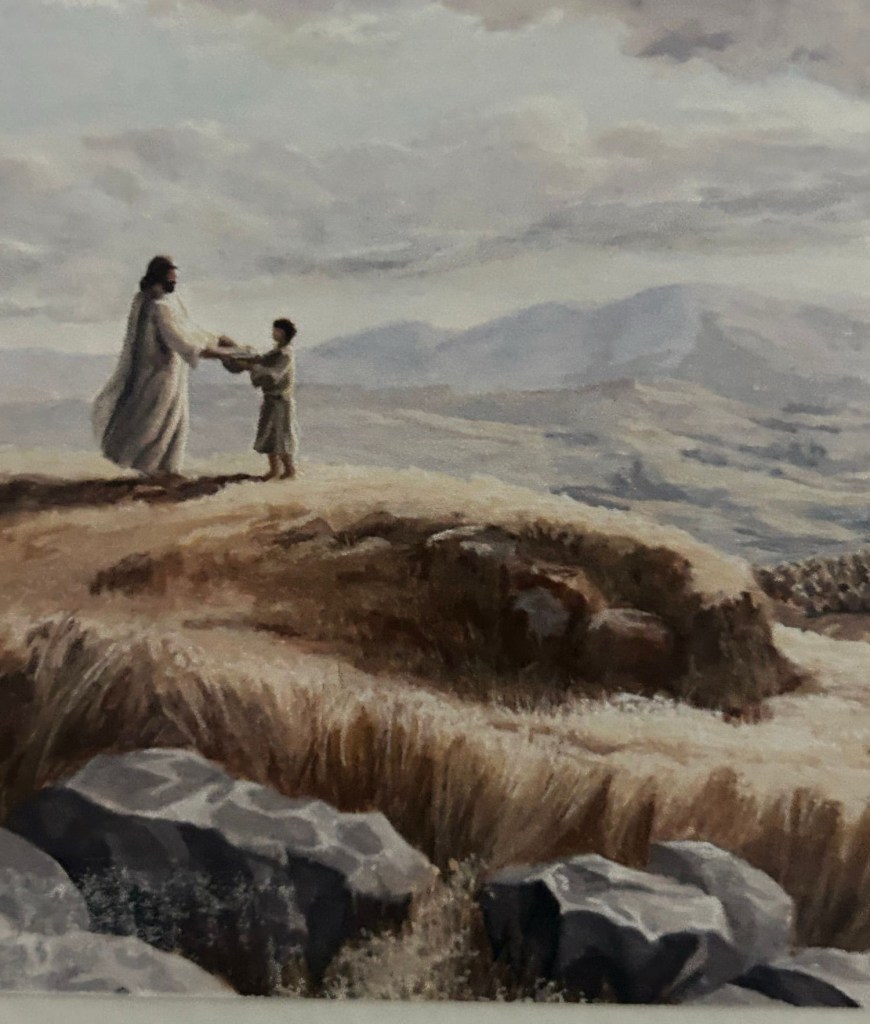
“I lift up my eyes to the mountains—where does my help come from? My help comes from the LORD, the Maker of heaven and earth.” — Psalm 121:1–2
What a wonderful thing it is to know where our help comes from. And even more wonderful to remember that it certainly doesn’t come from our ability to have everything figured out. Ha!
God is so very good at being God. Trust Him today.